Four Real-World Reasons pH Testing Matters
Middle & High School
“When Will I Ever Use This?” The timeless question that keeps educators on their toes.
Measuring pH is an essential lab skill that students learn, yet it often leaves them wondering why it matters beyond the classroom.
Watch their curiosity spark when they realize pH testing helps us understand how the world around us works. From healthy plants to safe swimming pools, students will be surprised to learn how this simple measurement guides decisions, solves problems, and keeps living things, including themselves, safe.
Below are four real-world examples that show how pH connects directly to daily life. Each one gives students a practical reason why this foundational skill is worth mastering.
1. Agricultural Soil Science & Plant Systems
Growers rely on pH to understand soil conditions because when soil becomes too acidic or too alkaline, plants can’t absorb key nutrients like nitrogen, phosphorus, and potassium. This impacts crop productivity, yield potential, and nutrient availability. One simple pH test supports soil fertility management, agronomic decision-making, and precision agriculture by guiding soil amendments for pH correction and greenhouse production. So, whether you’re managing acres of farmland or tending a backyard garden, understanding soil pH helps ensure plants get the nutrients they need to thrive.
To dig deeper into interpreting test results, see Hanna Instruments’ article “Decoding Your Garden Testing Results.”
2. Aquaculture & Natural Resources
Aquarium water chemistry can change quickly, and pH is one of the first indicators that something is off. Water quality management and fish health protocols depend on monitoring dissolved oxygen and ammonia-nitrogen relationships. A sudden drop in pH can stress aquatic livestock, damage gills, and cause harmful ammonia spikes, while high pH can disrupt biological filtration.
• A sudden drop in pH can stress fish, damage gills, and even cause harmful ammonia spikes.
• A pH that creeps too high can interfere with biological filtration or make certain minerals precipitate out of the water.
That’s why frequent testing is essential in sustainable aquaculture systems and hatcheries, because stable pH keeps entire aquatic ecosystems functioning smoothly. The same principles apply on a smaller scale: aquarium hobbyists rely on regular pH checks when introducing new fish, adjusting water sources, or troubleshooting algae, making this professional practice directly relatable at home.
It’s a perfect example of how a simple measurement helps keep living organisms swimming smoothly!
3. Food Science & Biotech
Fermentation is science in action. During fermentation, beneficial bacteria and yeast consume sugars and produce acids, lowering the pH over time. Monitoring pH helps brewers gauge fermentation progress and confirm safe acidity levels.
This ties to fermentation science, microbial activity, food safety thresholds, and quality assurance & control. Whether you manage a food processing facility or make home-brewed kombucha, this is important stuff to know!
A pH that’s too high can allow unwanted microbes to grow, while too low can affect flavor and slow bioprocessing. Acidity acts as a critical control point (CCP) in value-added agriculture. Kombucha is all about harmony; Goldilocks would be impressed.
Hanna Instruments explores this balance further in “The Science Behind Kombucha Brewing: pH & Titratable Acidity.”
4. Testing pH in Local Water Sources
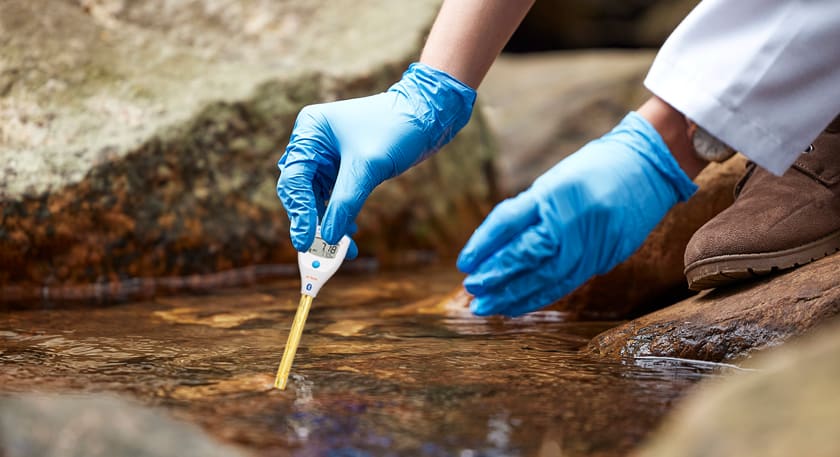
Students can explore pH in tap water, bottled water, groundwater, rain, ponds, and even pools. Water quality monitoring and environmental impact assessments rely on accurate pH readings.
• Low pH can indicate corrosive conditions
• High pH may signal mineral precipitation or reduced disinfectant effectiveness.
Testing supports sustainability, field diagnostics, and natural resource management standards.
The swimmers in your classroom may not realize it, but pH plays a big role in pool water comfort, clarity, and safety. Low pH can cause corrosion and irritation, while high pH reduces chlorine effectiveness and can lead to cloudy water and bacterial growth. That’s why everything, from backyard pools to massive aquatics centers and water parks, relies on routine testing to keep pH in the Goldilocks range.
This article breaks down the process “The Basics of Balancing Swimming Pool pH.” It can support your lesson plans on the essentials of acids, bases, and pH, and explores the different properties of each.
Free Classroom Resources: pH Skills Students Can Use Anywhere
To help students through a step-by-step process, we’re sharing two downloadable resources:
You can use them as warm-ups, quick-reference guides, exit tickets, lab-prep materials, or station activity sheets. They make it easier for students to build confidence and apply accurate technique, no matter what they’re testing.
Show students that this simple measurement protects life, improves quality, and keeps people safe using the same skills they’re learning in your classroom!
Recommended Products
[StartProductBlock]
Hanna Instruments Waterproof Pocket pH Tester with 0.1 Resolution
An easy-to-use device that simplifies water quality monitoring. Features 0.1 resolution with automatic two-point calibration and temperature compensation in a single, portable, pocket device.
[EndProductBlock]
[StartProductBlock]
Hanna Backpack Lab Water Quality Educational Test Kit
Extensive understanding of water quality through measurement of ten parameters. Assess the water quality of streams, rivers, and lakes. Includes portable test kits, pocket testers, lessons, and activities.
[EndProductBlock]
[StartProductBlock]
pH Indicator Papers and Test Strips
Measure the pH level of liquids and quickly determine if a solution is acidic, neutral, or alkaline.
[EndProductBlock]
[StartProductBlock]
Ward's® Essentials Acids, Bases, and the pH Scale Lab Kit
Examine the effects of acids and bases on chemical pH indicators and determine the composition of four unknown solutions.
[EndProductBlock]
