Ball Toss Activity: Measure, Model, and Analyze Motion
Middle & High School
A ball goes up. A ball comes down. Simple, right? But have students take a closer look, and they’ll discover just how much physics is happening in between.
A basic ball toss can open the door to some of the most important concepts in physics, from position and velocity to acceleration and free fall. But for students just learning to interpret motion graphs, connecting a moving object they can see to the lines and curves on a screen can be challenging.
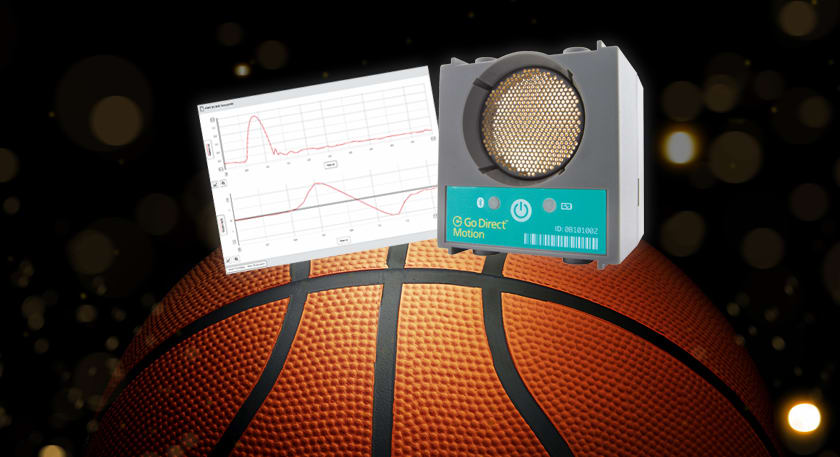
The Vernier Ball Toss Activity gives students a way to make that connection themselves. Using a Vernier Motion Detector and real-time data collection, students capture the position, velocity, and acceleration of a ball tossed vertically into the air. Then they analyze the resulting graphs to see how each representation tells a different part of the same motion story.
For middle school, high school, and AP Physics classrooms, it’s a hands-on way to turn graphing motion from an abstract exercise into a kinematics investigation students can see, measure, and analyze.
Predict it. Toss it. See what the data reveals.
The investigation starts by putting students’ own thinking to the test. They predict what the position, velocity, and acceleration graphs will look like, then collect real-time data to see how their predictions compare with what actually happens.
Vernier tools simplify classroom data collection and graphing, so students can spend more time asking the questions that matter: Why does the position-versus-time graph have that shape? How does velocity change as the ball rises and falls? What happens to acceleration throughout the toss?
One toss. Three ways to see motion.
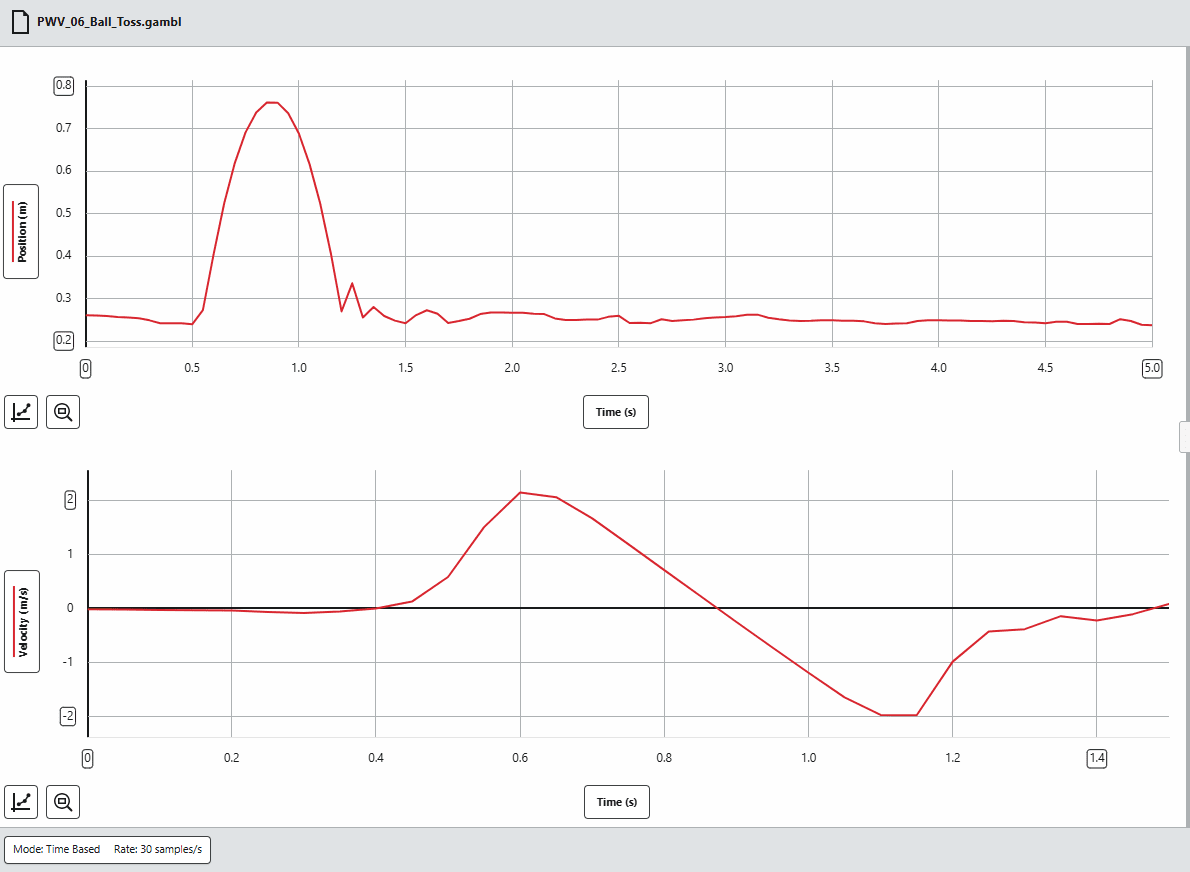
Students can watch a ball rise and fall, but position, velocity, and acceleration tell a much richer story. The Ball Toss sample results show how a single familiar movement can produce three distinct motion graphs. Students can compare position, velocity, and acceleration data, identify patterns, and connect what they observed in the air with what appears on the screen.
For example, the sample data shows the characteristic curved position-versus-time graph, while velocity changes approximately linearly during free fall. Instead of encountering these graphical relationships only in a textbook, students can investigate them using data generated by the activity.
From watching motion to investigating it
Seeing a demonstration can introduce a physics concept. Collecting and analyzing their own data gives students more to investigate.
Inspired students can take the ball and run with it. They can make predictions, look for patterns, compare results, and consider why experimental measurements don’t always match theoretical values exactly. The result is a science investigation activity that combines physical observation, graphing motion, and scientific data analysis.
The activity is also flexible enough to meet students where they are. Teachers can focus on understanding and interpreting motion graphs or extend the investigation into the more quantitative analysis expected in high school and AP Physics labs.
Easy setup. Plenty to discover.
Simple materials open the door to meaningful physics exploration. Using a ball and a Vernier Motion Detector, teachers can create an investigation that connects a familiar event to real-time motion data, interprets graphs, and makes sense of the relationships behind what students observe.
And because the technology handles much of the data collection and graph generation, teachers can keep the focus where it belongs: on student questions, observations, analysis, and understanding. Now, the ball’s in your court!
Download the Vernier Ball Toss Activity.
Ready for more ways to bring real-time data into your physics classroom?

Recommended Products
[StartProductBlock]
Vernier® Go Direct™ Motion Detector
Measures the position, velocity, and acceleration of moving objects by using ultrasonic pulses to detect distance over time. It connects via Bluetooth or USB to Vernier software such as Graphical Analysis.
[EndProductBlock]
